
National Public Relations Outreach Campaign
The Water Sports Foundation’s National Public Relations Outreach Campaign produced the largest online repository of boating safety content, using materials provided by the United States Coast Guard, the Water Sports Foundation, and other boating safety nonprofits, organizations and stakeholders. The purpose of the National Boating Safety Media Center was to create a comprehensive, one-stop resource featuring relevant boating safety content and statistical data, still and video images, and expert contacts available for media interviews.
The campaign created a curated database of national and regional media that cover boating and boating safety, including television, magazines, newspapers, radio, podcasts and social media. This database was developed and used during the project’s funding period in 2020 – 2021, resulting in 641 news stories and more than 1 billion potential media impressions. The database and media center continue to be a valuable resource for journalists and recreational boating safety advocates.

Video: Super Hero Life Jacket
Life jackets save lives. Boaters should be reminded that accidents are not predictable and therefore a life jacket should be worn at all times while boating. Watch this humorous interaction between a father and a son while choosing their favorite life jacket before a day on the water.
Read More
Video: New Life Jacket Labels Explained
This informative video explains the Coast Guard’s new life jacket labeling system showing boaters exactly what the new label’s icons mean and how to choose a new life jacket.
Read More
Video: Properly Sizing Children’s Life Jacket
This creative animated video reminds boaters of how important it is to have a child’s life jacket fit properly. The U. S. Coast Guard approved video shows examples of life jackets that are too big and how they may slip off the child during an emergency.
Read More
Boating Magazine Wins Video Awards
At the annual and prestigious Boating Writer’s International Awards, BOATING took away six awards, most notably completely sweeping the ”Boating Video” category.
Read More
Video: Life Jacket Proper Fit
Watch this informative video to learn how important a properly fitting a life jacket truly is. Improperly fitting life jackets can be dangerous so, in this video, you’ll also learn the critical steps to determining a properly fitting life jacket.
Read More
NSBC BoatBeat Blog: Alcohol and Boating Don’t Mix
Drunken passengers can easily fall overboard, swim near the propeller, lean over the side, or stand up in small vessels, causing vessels to capsize. Sun, wind, boat and wave action intensify the effects of alcohol.
Read More
NSBC BoatBeat Blog: Carriage of Fire Extinguishers
All extinguishers must be Coast Guard approved marine type extinguishers, and have a UL rating of 5-B or higher, which can be found on their label.
Read More
NSBC BoatBeat Blog: The Rules of the Road
The Navigation Rules are much like the rules of the road on the highway. They establish a consistent way to navigate safely and avoid collisions when two boats are crossing paths, are on course to meet head-on, or when one boat wishes to overtake another.
Read More
NSBC BoatBeat Blog: Carbon Monoxide
Exposure to carbon monoxide (CO) in large amounts or even small amounts for a long duration often results in death. CO is an odorless, colorless and tasteless gas in the exhaust produced in gasoline engines.
Read More
NSBC BoatBeat Blog: Search and Rescue Process
If a boater is in distress, they should contact search and rescue assets via VHF-DSC marine band radio, or with an EPIRB or PLB. It is the boater’s responsibility to contact search and rescue assets.
Read More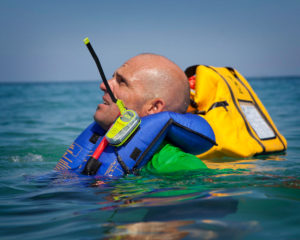
NSBC BoatBeat Blog: EPIRB and PLB
An Emergency Position Indicating Radio Beacon, or EPIRB, is used to alert Search and Rescue forces in the event of an emergency.
Read More
NSBC BoatBeat Blog: Emergency Engine/Propulsion Cut-Off Devices FAQ
Emergency engine/propulsion cut-off devices, sometimes referred to as an engine cut-off switch or kill switch, are a time-proven safety device used to stop the boats engines should the driver unexpectedly fall overboard.
Read More
NSBC BoatBeat Blog: VHF Radio with Digital Selective Calling (DSC)
The VHF radio with DSC is the most common emergency marine communications device, and with good reason: It’s simple to operate, communications go both ways, and when a boater hits the panic button, the U.S. Coast Guard will automatically know who the boater is.
Read More
NSBC BoatBeat Blog: Boating Emergency Preparedness
A boating emergency can happen anytime, anywhere — and does not only refer to a problem with the vessel, but also to any dangerous situation involving a passenger.
Read More
NSBC BoatBeat Blog: Boating Preparedness Recommendations
At a minimum, a boater should make sure that safety and other related equipment are on their vessel and in good working condition before each outing.
Read More
U.S. Coast Guard Boating Safety Division
The U.S. Coast Guard Boating Safety Division (CG-BSX-2) is dedicated to reducing loss of life, injuries and property damage that occurs on U.S. Waterways by improving the knowledge, skill and abilities of recreational boaters.
Read More
Jim Emmons
Jim Emmons is executive director of the non-profit Water Sports Foundation (WSF) and is a long-term recreational boating safety activist and enthusiast. He is serving in his second term on the United States Coast Guard’s National Boating Safety Advisory Council and currently serves as chairman. He also serves on NASBLA’s Paddlesports Committee and the national Sober Skipper Advisory Council.
Read More
Brian Goodwin
As the Technical Director at the American Boat and Yacht Council (ABYC), Mr. Goodwin is responsible for the managing the review and publication of over 70 standards. He also ensures the execution of numerous grants awarded to the ABYC Technical Department.
Read More